
This educational article is published by ALAO Invest LLC, which operates the Commonwealth funding portal. We created the newly renamed Inside the Rail series because many readers want to follow the horse associated with their investment while also understanding how their issuer security works.
Have a question or topic you’d love us to cover? Drop us a line anytime at hello@joincommonwealth.com—we’d love to hear from you!
Your horse runs a great race and hits the board—or, even better, wins.
You see the purse listed in the program, you know your horse earned a piece of it, and naturally the next question is:
When and how do I get my share?
This question comes up A LOT, and rightfully so. While the experience of following your horse is a huge part of the fun, purse earnings are also part of the economics of racehorse ownership.
The answer isn't quite as simple as taking the purse, dividing it by the number of shares, and dropping the money into your CW Wallet.
There is a lot more the money is doing behind the scenes, and today the curtain is pulled back for you.
First Things First: What Does "Purse" Actually Mean?
Let's say your horse enters a race with a $100,000 purse.
If your horse wins, ownership doesn't receive $100,000.
That purse is divided among the horses according to the conditions and rules governing the race. There isn't one universal purse distribution used by every racetrack in the country, but a common structure—and one used as an example for Kentucky Thoroughbred Development Fund purses—is:
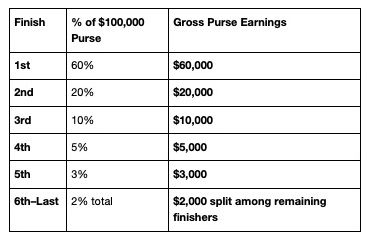
Actual purse distributions vary by racetrack, jurisdiction, race conditions, and incentive programs, so think of this as an educational example rather than a rule for every race.
So, in our hypothetical $100,000 race, winning the race means the horse earns $60,000—not $100,000.
From $60,000 to What Ownership Receives
There are expenses that come out of a horse's purse earnings before the remaining money makes its way to ownership.
Two of the most recognizable are the trainer and jockey percentages.
The exact amounts vary by jurisdiction and individual agreements. To give you a real-world example, Kentucky's Thoroughbred jockey-fee regulations currently provide, absent a different agreement, for a jockey to receive 10% for a winning mount in races with purses between $100,000 and $999,999, and 5% for second-, third-, and fourth-place mounts.
Trainer arrangements are contractual and can vary as well.
Generally, up to 25% of gross purse earnings may go toward trainer, jockey, and other applicable racing expenses and track-specific fees, depending on the race.
So our hypothetical win starts looking more like this:
$100,000 Listed Purse
↓
$60,000 Winner's Share
↓
Trainer + Jockey + Other Applicable Racing Deductions
↓
Net Purse Earnings to Ownership
That's an important distinction whenever you see a horse's published earnings.
Gross purse earnings are not the same thing as the dollars ultimately received by ownership.
Now Let’s Get to Your Commonwealth Shares
Here's another important piece.
Horses offered on Commonwealth have never represented 100% of a horse. They’re typically between 10-49% and vary on each offering, which you can explore in the app.
Let's say, purely for illustration, the LLC you bought shares in owns a 25% interest in a hypothetical horse.
If the horse earns $60,000 for winning and, for simplicity, assume $48,000 remains after applicable racing deductions, the LLC wouldn't receive the entire $48,000.
Its proportional share would be:
$48,000 × 25% = $12,000
That $12,000 would be the amount attributable to the offering in this simplified example.
From there, your economic participation is based on the number of shares you own and the terms of that specific offering.
That's why the race-entry emails include estimated returns per share if the horse finishes first, second, or third. This helps translate the stated purse you see in the program into something that's more meaningful to you as a shareholder.
Okay, You Won. Where's the Money?
Here's one of those behind-the-scenes pieces of racing that isn't obvious when you're standing in the winner's circle:
Purse money generally doesn't arrive immediately after the race.
With many racetracks, it can take 30–60 days or longer for purse earnings to be released to the horse's managing member.
Once the applicable funds are received, they're transferred into the Issuer's dedicated bank account and accounted for at the series level.
So if your horse wins on Saturday and you don't see money in your CW Wallet on Monday, don't panic.
Everyone may still be waiting on it, too.
Why Not Distribute Every Dollar as Soon as It Arrives?
This is probably the most important question in this entire article.
Commonwealth generally facilitates distributions once the Manager determines the amount available for distribution reaches at least $4 per share, while also making sure the series maintains at least one full year of operating capital after the distribution.
There are two big reasons for that.
1. Very Small Distributions Can Be Expensive
Even a small distribution can create accounting, administrative, and tax-reporting requirements.
If every few cents or dollars were distributed as soon as they became available, the costs associated with processing those distributions could work against shareholders rather than benefit them.
It’s better to wait until there's a meaningful amount to distribute.
2. The Horse Still Has Bills to Pay
This is the part that's easy to forget after a big win.
The horse still has to go back to the barn on Monday.
Training continues. So do veterinary care, farrier work, transportation, and other costs associated with keeping a racehorse healthy and in training.
And horses don't always follow a budget perfectly.
A horse may need an unexpected veterinary procedure. It may need additional time off. Transportation expenses may change. A campaign may last longer than originally projected.
That's why it's not only about how much money a horse has earned when determining whether to make a distribution.
It’s important to also look at how much capital the series reasonably needs to continue supporting that horse.
Working-capital projections are estimates, and actual costs may exceed an issuer’s reserves. If that occurs, the consequences depend on the applicable offering and governing documents and may include delayed or reduced distributions, Manager funding or loans, or additional securities that could dilute existing investors.
What Happens to the Money While Everyone Waits?
Funds earned by the horse and attributable to the series remain accounted for within the LLC until they're used or distributed in accordance with the offering.
That's probably the easiest way to think about this:
Earning purse money and making a shareholder distribution are two separate events.
A horse can be earning money while the series is building toward the point where making a distribution makes financial sense.
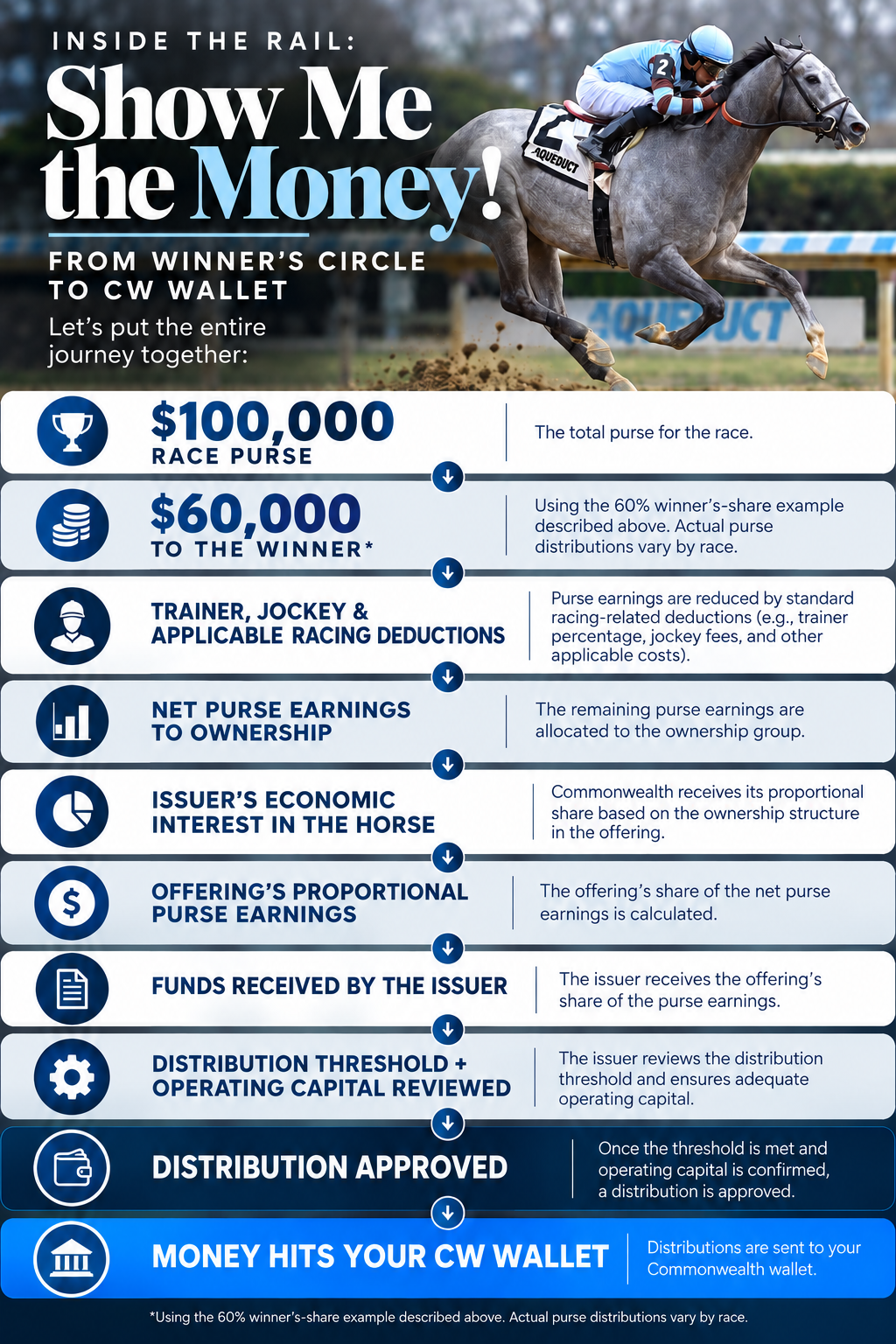
Once a distribution is processed, you'll receive an email letting you know that funds have been deposited into your CW Wallet.
From there, you can withdraw the funds using your payout method on file. You can learn how to do that here.
When a distribution is made, the applicable series financial information is provided via email so you can see how the distribution was determined.
Key Takeaways
The advertised purse isn't what ownership takes home. The purse is divided among finishers, and trainer, jockey, and other applicable expenses may be deducted from the horse's gross earnings.
Investors participate through shares in a horse-specific issuer, which typically owns only a portion of the horse’s economic interest. Your share of the economics, including purse earnings, is based on the issuer’s interest in the horse and the terms of the offering.
Purse money takes time to arrive. It can take 30–60 days or longer before the funds are actually received.
A purse payment does not automatically trigger a distribution. The Manager may consider the amount available per Class A Unit and the issuer’s anticipated operating-capital needs, together with the applicable governing and offering documents; a distribution is not guaranteed.
Funds received by the issuer remain accounted for at the issuer level until they are used for authorized expenses or distributed under the applicable documents. Those funds are not protected from issuer expenses or losses, and no distribution is guaranteed.
There aren't many feelings in racing better than watching your horse cross the wire first.
And seeing money land in your CW Wallet afterward isn't too bad either.
But there's a lot that happens between those two moments.
The Manager evaluates whether funds are available for distribution while considering the issuer’s anticipated expenses and reserves under the applicable governing and offering documents.
Because sometimes the best thing with some of the money a horse earns today is to make sure that horse has the opportunity to go out and earn again tomorrow. Sometimes, keeping some of the money a horse earns today helps support its ongoing expenses and the opportunity to race again tomorrow. That may reduce or delay distributions, and future purse earnings are never guaranteed.
Important: Purse structures, racing deductions, issuer ownership percentages, expenses, and distribution amounts vary by race and issuer. Examples in this article are hypothetical and provided for educational purposes only; they are not projected or guaranteed investment returns. Distributions are not guaranteed and remain subject to the applicable offering and governing documents. Regulation Crowdfunding investments are speculative, illiquid, and may result in the loss of the entire investment.
