One question we hear often is simple:
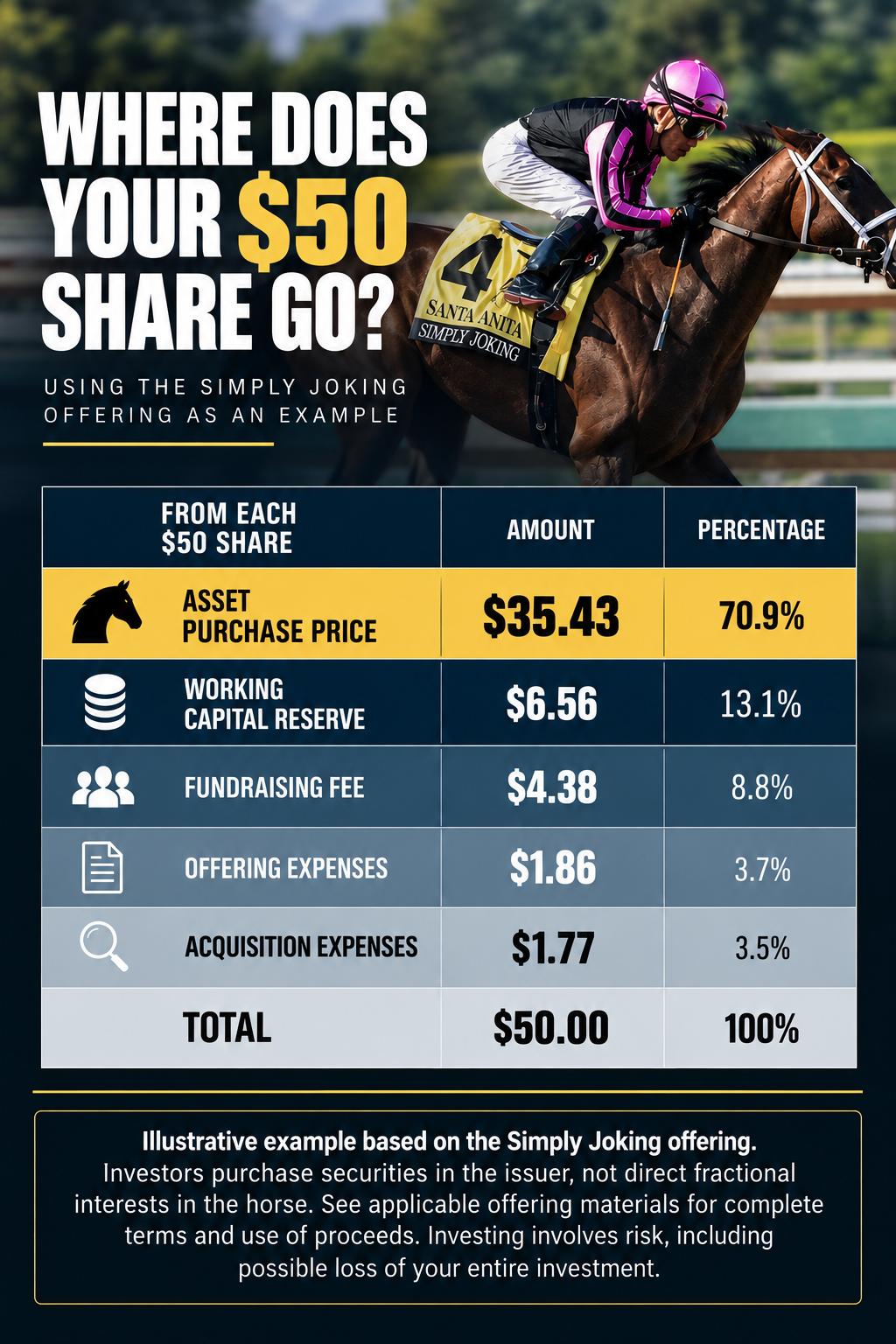
Where does my $50 actually go when I buy a share?
It's a good question—and there's quite a bit packed into that $50.
Before Commonwealth, getting an economic interest tied to a racehorse like this typically meant writing a much, much bigger check. By structuring these offerings into microshares, Commonwealth gives everyday racing fans access starting at $50 per share, typically with a 2-share minimum—an opportunity that otherwise may not be available at that investment level.
This educational article is published by ALAO Invest LLC, which operates the Commonwealth funding portal. It uses the Simply Joking offering only to illustrate the allocation categories disclosed in that offering. It is not a recommendation or a substitute for the issuer’s filed offering materials.
The Big Picture
SIMPLY JOKING
Price Per Share: $50.00
Total Offering Amount: $592,700
Shares Offered: 11,854
One of the biggest misconceptions about microshare racehorse offerings is that a share's price simply represents the horse's purchase price. That’s part of it, but there’s A LOT more.
It includes ownership interest, but also funds your proportional share of costs necessary to acquire, care for, train, insure, manage, and potentially race that horse.
For this offering, the stated budget includes 15 months of projected training and working capital. Any investor payment obligations are governed by the filed offering materials and the issuer’s governing documents.
So, let's break down that $50.
$35.43 — Asset Purchase Price
This is the largest part of the share price and probably the easiest to understand: it represents the cost of buying the ownership interest in the offered horse.
The offering materials state that the issuer expects to acquire up to a 15% interest in the horse. Investors are being offered securities in the issuer—not direct fractional interests in the horse.
That portion is valued at $420,000. Spread across the 11,854 shares being offered, approximately $35.43 of each $50 share is allocated to the Asset Purchase Price.
In other words, 71% of the $50 price per share is the horse interest itself.
$6.56 — Working Capital Reserve
These expenses come with getting—and keeping—that horse progressing forward (and hopefully into the winner’s circle).
For this offering, $6.56 per share is allocated to the Working Capital Reserve, which can range from 15-36 months of projected expenses, depending on factors such as the horse’s age and anticipated timeline toward a potential racing debut. Younger horses farther from the starting gate generally require a longer projected runway.
If you’re thinking about this in terms of a business, it’s the horse's operating budget. These expenses typically include:
-
Training and boarding
-
Routine veterinary care
-
Farrier/blacksmith expenses
-
Transportation/shipping
-
Race-related expenses
-
Specialized healthcare (veterinary, chiropractic, rehabilitation, surgery)
-
Insurance
-
Aftercare donation
-
Other costs associated with maintaining and campaigning the horse
-
Costs of operating the LLC, such as tax preparation, accounting, government fees, mailings, and transfer agent.
It’s important to provide these funds upfront because it gives the horse's management team a defined pool of capital to work from without returning to shareholders every month with another bill (like other types of syndicates).
As many of you know, racehorses don't often develop on a planned timeline. In fact, a common saying in this game is, “Don’t tell a horse your plans.” A horse may need additional time before its first start, encounter a minor setback, or simply benefit from patience. Building a longer runway into the offering helps account for the realities of developing a Thoroughbred.
If the horse is sold or retired before the end of their projected capital period, any unused capital will be handled under the offering materials and the issuer’s governing documents; no return or distribution is assured.
$1.77 — Acquisition Expenses
Before a horse appears in the Commonwealth app, plenty of work goes into finding and evaluating the horse with the help of a skilled bloodstock agent.
For this offering, $1.77 per share is allocated to Acquisition Expenses.
These costs include bloodstock fees, veterinary checks, and other miscellaneous costs before a horse is offered on Commonwealth. A bloodstock agent typically leads this process and specializes in finding and purchasing horses through private and public sales.
Depending on the transaction, that can include their bloodstock agent fees, research, expert due diligence, bank or financing-related expenses, and similar acquisition costs.
Put simply: this is part of the cost of getting from "we like this horse" to actually getting the horse into the offering.
$1.86 — Offering Expenses
Racehorse offerings available on the Commonwealth platform are also a securities offering.
That means legal, accounting, escrow, regulatory, and compliance requirements are involved in bringing it to investors.
For Simply Joking, $1.86 of each share is allocated to Offering Expenses associated with executing the offering.
This distinction matters because these aren't expenses related to whether the horse can run fast. They're costs associated with creating the investment itself.
$4.38 — Fundraising Fee
Finally, $4.38 per share is allocated to the Fundraising Fee paid to the Commonwealth funding portal in connection with the offering.
This category is separate from the costs of caring for and racing the horse; it covers the costs of conducting the fundraising through the offering. That includes technology and platform infrastructure, offering preparation, investor administration, financial operations, communications and reporting, customer support—and, of course, the friendly faces at Commonwealth who help make the experience possible.
So, What Does $50 Look Like?
Here's the simplest way to visualize this offering:
|
From Each $50 Share |
Allocation |
|
Asset Purchase Price |
$35.43 |
|
Working Capital Reserve |
$6.56 |
|
Fundraising Fee |
$4.38 |
|
Offering Expenses |
$1.86 |
|
Acquisition Expenses |
$1.77 |
|
Total |
$50.00 |
Another way to think about it: about 71% of the share price is attributable to the Asset Purchase Price (the cost to buy the horse), while the remainder supports the acquisition, operating costs, and administration of the offering, plus expenses related to the horse and shareholder experience.
Why Include 15+ Months of Working Capital?
This may be the most important part of the entire breakdown.
Owning a racehorse isn't a one-time expense. There are training bills every month. Horses need shoes. They need veterinary care. They travel. They may have race-entry fees. And sometimes they need something nobody could have predicted when the offering was created, such as surgery, extended time off, or rehabilitation.
That creates an important balancing act when building an offering: raise enough working capital to cover the horse's anticipated expenses, but not more than reasonably necessary.
Raise too little, and the series could run out of money before the anticipated ownership period ends. That risk can increase if a horse takes longer than expected to reach the races or earns little in early-career purses. Because shareholders are never asked to contribute more money later, getting that estimate right from the beginning matters.
Raise too much, however, and shareholder capital could sit in reserve unnecessarily instead of funding the horse's ownership and operations.
For this offering, that balance resulted in including 15 months of projected training and working capital upfront. That means you're not simply paying today's purchase price and worrying about tomorrow's training bill later. The goal is to fund the anticipated ownership period from the beginning, while raising only what is reasonably expected to be needed.
Key Takeaways
A $50 share does not mean $50 goes toward purchasing the horse. In the Simply Joking offering, $35.43 per share is attributable to the Asset Purchase Price, while the remainder funds the other costs and capital associated with acquiring, offering, managing, and supporting the investment.
The $6.56 Working Capital Reserve is especially important because racehorse ownership comes with ongoing expenses, and this offering includes 15 months of projected training and working capital.
Finally, the price per share incorporates costs associated with operating a regulated securities offering—not just the costs you'd encounter if you personally bought a horse at a sale.
The Big Picture
When you see $50 per share in the Commonwealth app, there's a lot happening behind that number.
Part of it buys the horse interest.
Part of it helps fund the horse's future.
And part of it covers the work required to acquire, structure, administer, and manage the offering and shareholder experience.
At the end of the day, the $50 is the purchase price of a security issued by a racehorse LLC—not a direct fractional interest in the horse—and the applicable offering materials describe how the issuer expects to use the proceeds.
Important: Investing in racehorse LLCs involves significant risks, including the possible loss of your entire investment. Offering terms, expenses, reserves, fees, and the treatment of unused funds are governed by the applicable offering materials. Investors should review the offering documents in their entirety before investing.
